A discharge summary records a hospital episode. Do not treat it as confirmation that a particular airline has accepted your return journey. Put two separate questions to the people responsible: what does the treating clinician advise about the proposed journey, and what does the carrier require before it will carry you?
The UK Civil Aviation Authority's passenger guidance describes an initial information stage and, where the airline has concerns, a further form and possible medical proof. Its professional guidance places the final carriage decision with the airline. These UK sources explain the distinction; they do not establish the rules of a Chinese hospital or a specific international itinerary.
Assign each confirmation to its owner
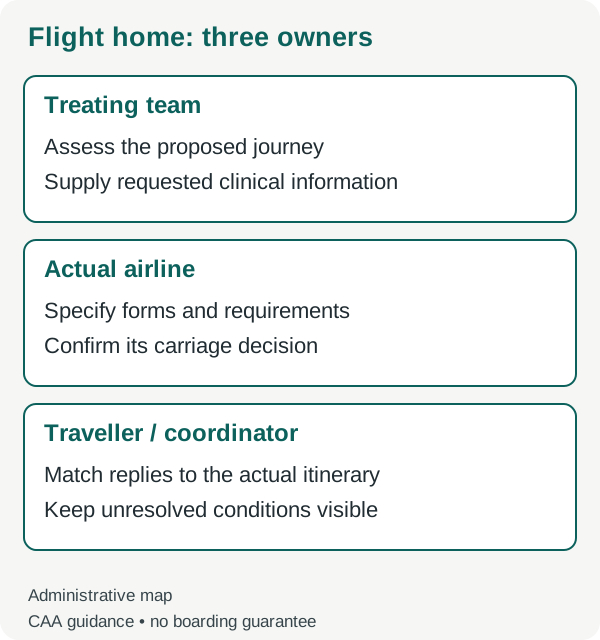
Figure: a responsibility map for the return journey. Original administrative diagram informed by the two CAA sources above. The three boxes represent different tasks, not three approvals or a guaranteed sequence. A ticket, hospital letter or completed form alone does not close all three tasks.
Start with the actual journey
Send the airline a clear administrative enquiry naming the flight and date. Ask which department handles medical clearance, whether a carrier-specific form is needed, who completes it, how it is submitted and when a response can be expected. If several carriers operate the itinerary, ask which requirements apply to each segment. Do not assume that the company selling the ticket has answered for every operating carrier.
Take the requested form to the treating team. Ask who can assess the proposed journey and supply the requested clinical information. A travel coordinator can help route documents; that role does not make the coordinator the clinical assessor or the airline decision-maker.
Keep a small confirmation record
Write down the carrier contact, form version, submission reference, response date and any unresolved conditions. Keep the clinical documents in the airline's approved private channel. This site does not collect records or issue fitness certificates.
If support is needed, ask specifically what has been arranged: airport assistance, help during the flight and a companion are separate practical questions. Ask the carrier what information it needs rather than assuming that a general assistance request resolves medical clearance.
If the route, departure date or clinical situation changes, ask the relevant team whether its earlier answer still applies. Mark an unanswered question as unresolved. Do not turn silence or a booking confirmation into medical clearance.
Plan the handoff after arrival too
The follow-up handoff worksheet covers records and responsibility after returning home. It serves a different purpose from the carrier enquiry. Keep both tasks visible without treating either worksheet as permission to travel.
Sources checked on 6 November 2026; neither CAA page displayed a revision date. This guide supplies no safe waiting period, individual assessment, insurance decision or boarding guarantee. Confirm clinical advice with the treating clinician and carriage requirements with the actual airline.